
- Kid3 is an Audio Tagger. If you want to easily tag multiple MP3, Ogg/Vorbis, FLAC, MPC, MP4/AAC, MP2, Opus, Speex, TrueAudio, WavPack, WMA, WAV and AIFF files (e.g. Full albums) without typing the same information again and again and have control over both ID3v1 and ID3v2 tags, then Kid3 is the program you are looking for.
- Kid3 - Efficient Audio Tagger With Kid3 you can: - Edit ID3v1.1 tags - Edit all ID3v2.3 and ID3v2.4 frames - Convert between ID3v1.1, ID3v2.3 and ID3v2.4 tags - Edit.
- Kid3 is an application to edit the ID3v1 and ID3v2 tags in MP3 files in an efficient way. Also tags in Ogg/Vorbis, Opus, DSF, FLAC, MPC, APE, MP4/AAC, MP2, Speex, TrueAudio, WavPack, WMA, WAV, AIFF files and tracker modules (MOD, S3M, IT, XM) are supported.
Kid3 is an open-source cross-platform audio tag editor for many audio file formats, it can
- Edit ID3v1.1 tags
- Edit all ID3v2.3 and ID3v2.4 frames
- Convert between ID3v1.1, ID3v2.3 and ID3v2.4 tags
- Edit tags in MP3, Ogg/Vorbis, FLAC, MPC, MP4/AAC, MP2, Opus, Speex, TrueAudio, WavPack, WMA, WAV, AIFF files and tracker modules (MOD, S3M, IT, XM)
- Edit tags of multiple files, e.g. the artist, album, year and genre of all files of an album typically have the same values and can be set together.
- Generate tags from filenames
- Generate tags from the contents of tag fields
- Generate filenames from tags
- Rename and create directories from tags
- Generate playlist files
- Automatically convert upper and lower case and replace strings
- Import from gnudb.org, TrackType.org, MusicBrainz, Discogs, Amazon and other sources of album data
- Export tags as CSV, HTML, playlists, Kover XML and in other formats
- Edit synchronized lyrics and event timing codes, import and export LRC files
Kid3 audio tag editor 3.8.6 was released a few days ago with new features and important bug-fixes. PPA has updated for Ubuntu 18.04, Ubuntu 20.04, and Ubuntu 20.10. Kid3 3.8.6 adds support for building with Qt 6. And it now provides a nicer default style for Windows users. The new release features: adds sub tracks support in Discogs import. The invention provides the identification and characterization of disease and cancer-associated epitope, KID3. The invention also provides a family of monoclonal antibodies that bind to KID3, methods of diagnosing and treating various human cancers and diseases that express KID3.
Kid3 is developed in his spare time by Urs Fleisch, a Zurich based professional developer, who also uses Qt in his daily work.
Urs started working with Qt in 2002, the first version of Kid3 was released 2003 as a KDE application for MP3 files (hence the name starting with a K and ending with ID3).
Kid3 has grown for more than 12 years now, it has experienced Qt 2, 3, 4, and 5, today it supports a lot of audio formats and runs on all major desktop operating systems.
Kid3 is Urs’ largest spare time project. He also supports other open source projects with bug reports and patches, and has contributed, among other things, to the Linux kernel, Android, Emacs, Matplotlib, KDE, LXDE, TagLib, Debian and Ubuntu. Another notable larger contribution was improved Python code completion for Emacs (python-mode.el).
 Go back
Size: 18.4MB
License: FREE
Publisher:Publisher | Listed Programs
Kid3 Download
Release Date: 2021-02-01 | Changelog
Submit Date: 2021-02-01
OS: Windows XP/Vista/7/8/8.1/10 (32-Bit/64-Bit)
Downloads: 7680
Popularity:
 Editor's Rating
Do you have some audio tracks whose tags you would like to edit? Kid3 is a handy application that will make your work especially easy if you have multiple tracks with similar details. The portable tag editor is compatible with many audio formats, including MP3, WAV, FLAC, WMA, OGG, MPC, AIFF, AAC, WavPack, Opus, TrueAudio, Speex and tracker modules.
Using Kid3 Audio Tagger
Being a portable application, we downloaded and extracted the application files to our preferred destination. We chose a flash drive to make it truly portable. The program's user interface was divided into five parts: the left side featured directory and file listboxes while the right one contained Tag 1, Tag 2, Tag 3 and File sections.
One of the things we liked about the program was the ability to edit both ID3v2 and ID3v1 tags in MP3 audio files. Many of the tag editors out there allowed us to edit either of the tags but not both. We could even convert one type of tag to another. Next jump: shmup tactics.

We set details like album, artist, genre and year to the same values when handling audio files that required similar information. We then applied them to all the files at the same time, allowing us to save significant time and avoid the monotony associated with entering the same information over and over.
The program made it even easier for us when the details we wanted were contained in the audio file names, as it allowed us to generate tags from the names. Conversely, we could create file names from tags. The editor ensured consistency when creating names by automatically controlling lower and upper case characters and replacing substrings or characters to get rid of illegal characters.
Kid3d
We selected all the audio files whose tags we wanted to edit and clicked the 'To: Tag 1' button under the 'File' section to set track, album, artist and title values. We set genre and year values by respectively selecting the appropriate genre in the 'Genre' combobox and typing the desired year.
Kid3 can extract information for full albums from such websites as Discogs, TrackType.org, gnudb.org, MusicBrainz and Amazon. We easily configured the import format using regular expressions. We could also export the details in Kover XML, playlist, HTML and CSV formats.
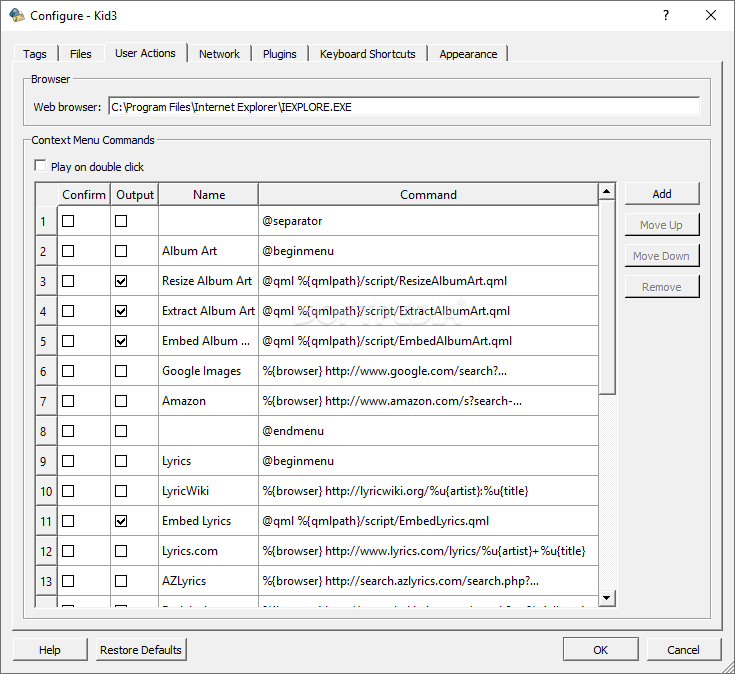
In addition to creating tags and files names, the program enabled us to generate playlist files. Right-clicking a file displayed a context menu that gave us the options to expand or collapse all, rename, move to trash or play the file.
Conclusion
Kid303
Kid3 is an intuitive audio tag editor that allows batch editing for faster operations. You can use it to generate tags from file names or vice versa. You can use it to edit both ID3v2 and ID3v1 tags, and there is no steep learning curve to climb.